Cambridge Sculpture Trails

Trail 3

West Cambridge

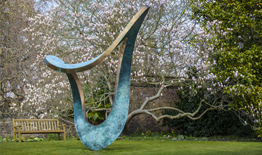
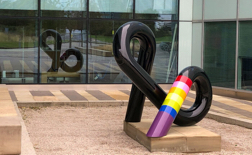
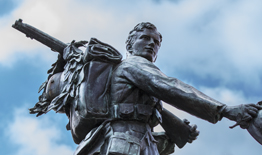
Trail 3 is an attractive and tranquil walk that provides the delightful experience of viewing sculpture within several college gardens where the settings change with the passing seasons. This West Cambridge walk may be accessed from the Madingley Road Park & Ride buses that also connect to the city centre. There are no refreshments available en-route. Starting at Churchill College the walk takes approximately two hours as it continues to Trinity Hall’s Wychfield Site followed by Murray Edwards College. It ends at the Isaac Newton Institute for Mathematical Sciences in Clarkson Road with its impressive ‘Universe’ series of three steel sculptures.


Churchill College

Storey’s Way
Tel: 01223 336000
www.chu.cam.ac.uk

Entry may be restricted during exams mid April – mid June. Start at Porters’ Lodge and collect a map – leave by Churchill Road, continue along Storey’s Way to Trinity Hall, Wychfied Site.

Lynn Chadwick  Beast Alerted 1 1990

1: Lynn Chadwick

Beast Alerted 1 1990

Stainless steel

Lynn Chadwick (1914-2003) had a working background in architectural draughtsmanship before turning to sculpture. His early sculptures were constructions of hanging or standing mobiles using technical experimentation with metal rods and developing his expertise as a welder.  Chadwick’s human and animal forms often portray basic emotions such as aggression, fear and watchfulness, with his later work becoming more humorous. Acclaimed internationally his works are held in public collections worldwide.

www.lynn-chadwick.com


Dhruva Mistry  Diagram of an Object (Second State) 1990

2: Dhruva Mistry

Diagram of an Object, Variation (second state) 1990

Bronze

Dhruva Mistry (b 1957) was born and educated in India, returning in 1997 to live and work in Gujarat.  A British Council Scholarship to take a MA in sculpture at the Royal College of Art brought him to Britain. He was Artist in Residence at Kettle’s Yard with a Fellowship at Churchill College (1984-1985). Hinduism, Buddhism, West Egyptian and Cycladic Art, together with European traditions of figurative sculpture, influence his work. Internationally shown in group exhibitions, his work is also held in public collections in U.K, Japan and India.

Mistry says of this work “it is a structured puzzle about how the eye sees the object and how the mind prefers to perceive it”.

www.dhruvamistry.com


Bernard Meadows  Pointing Figure with Child 1966

3: Bernard Meadows

Pointing Figure with Child 1966

Bronze

Bernard Meadows (1915-2005) was a studio assistant to Henry Moore when young, returning to work with Moore in the late1970s.  His work is mainly in bronze and although abstract is often based on animal and plant forms suggesting human characteristics. His early pieces related to fear and defence as part of the human condition in the wake of World War II and the Cold War that followed. Meadows developed an interest in finishes, and in this sculpture he used different degrees of polishing adding light and contrast in order to accentuate a shape within the overall form.

www.sculpture.org.uk/artists/BernardMeadows


Sean Crampton  Three figures 1970

4: Sean Crampton

Three Figures 1970

Bronze

Sean Crampton (1918-1999) started a career as a silversmith before studying sculpture at Fernand Leger’s studio in Paris. After distinguished service in World War ll he created a war memorial for his own regiment. He produced large works for civic organisations, typically colleges, churches and convents. History, mythology, and spiritual matters were subjects of interest to him and he favoured working in bronze and welded phosphor bronze.

www.guardian.co.uk/news/1999/aug/19/guardianobituaries1


Peter Lyon  Flight 1981

5: Peter Lyon

Flight 1981

Bronze

Peter Lyon (1926-2002) was a Fellow Commoner in the Arts at Churchill College 1979-1981.  This work was commissioned by the Roskill family to commemorate Captain Roskill, a Fellow of Churchill. In addition to sculpture Lyon also made jewellery and was a senior lecturer in jewellery design at Central St. Martins College of Art and Design.


6: Michael Dan Archer

To Boullée 1993

Granite

Michael Dan Archer (b 1955) made this work in homage to the French visionary architect, Boullée.  Physical transformation through the working and grinding of stone and psychological transformation as evoked by symbolic imagery are key to Archer’s purpose. 

Another sculpture by the same artist, Dream is at the Wychfield Site also features at No 11 on this Trail. A third work by Michael Dan Archer, Gog and Magog 2003, cast iron and granite, can be seen outside Eastbrook, the Government buildings, Shaftesbury Road on weekdays only.     

www.archersculpture.co.uk


Dame Barbara Hepworth  Four Square Walk Through 1966

7: Barbara Hepworth

Four Square Walk Through 1966

Bronze

Barbara Hepworth  (1903-1975) received academic and national honours; exhibited around the world and was made a Dame of the British Empire in 1965. She was part of the St. Ives group of artists and while in Paris, met Picasso, Brancusi and Mondrian. A commitment to abstract art led to her interest in geometric abstraction. Later she created models for casting in bronze, the sculptures growing in scale as can be seen at her garden museum in St Ives.      

Another sculpture by Barbara Hepworth, Ascending Form (Gloria) at Murray Edwards College is at No 16 on this Trail. 

Divided Circle 1969 by Barbara Hepworth at Clare College can be seen on Trail 2,  No 14.

www.tate.org.uk/stives/hepworth


Michael Gillespie  Spiral 1991

8: Michael Gillespie

Spiral 1991

Cement with resin skin

Michael Gillespie (1929-2012) made small casts for Epstein and later for Frink. His work became increasingly abstract following his listening to shapes. He stated “the sculptures must speak for themselves, as is proper”.  

http://freespace.virgin.net/mn.gillespie/


Denis Mitchell  Gemini 1973

9: Denis Mitchell

Gemini 1973

Marble

Denis Mitchell (1912-1993) worked as a tin miner near Land’s End when young and then again during the war, leading to his interest in hewing, carving and handling tools. After the war he became integral to the St Ives group of artists. He was Barbara Hepworth’s chief assistant, later becoming a teacher until he gave up work to sculpt full time. He was a founder member of the Penwith Society of the Arts and he also founded Porthia Textile Prints.

www.sculpture.uk.com/artists/denis_mitchell/


Trinity Hall, Wychfield Site

Storey’s Way
Tel: 01223 339029 (Wychfield Site)
Tel: 01223 332500 (Trinity Hall)
www.trinhall.cam.ac.uk

Entry is through the Porters’ Lodge, Storey’s Way. To continue the walk to Murray Edwards College, Huntingdon Road leave via green gate (exit only) onto Huntington Road.

Jonathan Clarke  Twelve 2006

10: Jonathan Clarke

Twelve 2006

Cast and welded aluminium

Jonathan Clarke (b 1961) works primarily in sand and cast aluminium. This work is a unique piece using expanded polystyrene that is vaporised in the process of creation. Clarke uses the technique originally developed by his father.

www.jonathanclarke.co.uk


Michael Dan Archer  Dream 2002

11: Michael Dan Archer

Dream 2002

Chinese granite

Michael Dan Archer (b 1955) is noted for his use of the physicality of stone in relation to architecture and landscape. He created this work after a dream brought him inspiration.  

Another sculpture by the same artist, To Boullée, is at Churchill College, No 6 on this Trail. A third work by Michael Dan Archer, Gog and Magog  2003, cast iron and granite, can be seen outside Eastbrook, the Government Buildings, Shaftesbury Road on weekdays only.

www.archersculpture.co.uk


Murray Edwards College (formerly New Hall)

Huntingdon Road
Tel: 01223 762100
www.art.newhall.cam.ac.uk

Enter via Huntingdon Road. It is essential to report to the Porters’ Lodge. Exit via Storey’s Way to continue to Clarkson Road by footpath from Madingley Road.

Vicki Olverson  Turkhana Woman with Fish 2004

12: Vicki Olverson

Turkhana Woman with Fish 2004

Painted papier mâché

Vicki Olverson (b1956) is a painter and sculptor who has exhibited widely, her work developing from representational to abstract. In order to produce large sculptures she uses papier mâché strengthened with a high proportion of resin glue. Her inspiration comes from a love of Africa and her time in Kenya where she worked and travelled over a period of three months. Born in Wallasey, Merseyside, she has an affinity to the coast and sea which are also key in her work.

www.art.newhall.cam.ac.uk  


Annie Collard  Festive Feeling 1988

13: Annie Collard

Festive Feeling 1988

Painted steel

Annie Collard (b 1946) says of this work, “…  the coils were inspired by the tension of an athlete about to spring away from the starting block”. Her aim was to create a delicate form from a hard and durable material. She has made larger-scale sculptures for corporate collections.     

www.art.newhall.cam.ac.uk    


Judith Cowan  Nothing Lasts for Ever 1989

14: Judith Cowan

Nothing Lasts Forever 1989

Corten steel, stainless steel and gneiss

The artist says of this sculpture “the domestic vocabulary of the work encourages daydreams.  Here, the vast apparently falling bucket invites childhood fantasies as you stare into its interior”.  Further explanation of this work is in the virtual gallery section of the art collection at Murray Edwards College - see website below.  

Another sculpture by the same artist, Skin and Blister, is also at Murray Edwards College, No 17.

www.judithcowan.com

www.art.newhall.cam.ac.uk  


Wendy Taylor  Three Dung Beetles 2000

15: Wendy Taylor

Three Dung Beetles 2000

Bronze

Wendy Taylor (b 1945) has two distinct strands to her work; large abstract pieces that appear to be in precarious balance and drawings and sculptures of animals and insects, anatomically correct and realised in minute detail. Her commissioned sculpture can be seen in public places throughout Britain.

Another sculpture by the same artist, Jester 1994, at Emmanuel College features on Trail 2, No 9.

www.wendytaylorsculpture.co.uk

www.art.newhall.cam.ac.uk  


Dame Barbara Hepworth  Ascending Form (Gloria) 1958

16: Barbara Hepworth

Ascending Form (Gloria) 1958

Bronze

Barbara Hepworth (1903-1975) was inspired by music to produce this work following her friendship with the composer Priaulx Rainier. Hepworth was the first sculptor noted for piercing her work to create a hole, resulting in a positive and a negative space in the form. A garden museum of her work may be visited in St Ives, Cornwall where she lived amongst a group of artists, her work often relating to the coast and landscape.

Another sculpture by the same artist, Four Square Walk Through is at Churchill College, No 7 on this Trail. Also, Divided Circle 1969 by Barbara Hepworth at Clare College is at Trial 2, No 14.

www.tate.org.uk/stives/hepworth


Christine Fox  Gathering of Owls IV 1989

18: Christine Fox

Gathering of Owls IV 1989

Painted engraved slate on aphrormosia

Christine Fox (b 1922) chose to locate her sculpture on the site of the former aviary of the Darwin family. The piece is representative of Fox’s use of organic materials to suit the nature of the subject and its environment. Ancient Welsh roofing slates were patinated and engraved with symbols of mazes and spirals to represent the importance of owls in antiquity and pre-Christian belief.

www.art.newhall.cam.ac.uk               


Austin Wright  Plantation 1976

19: Austin Wright

Plantation 1976

Aluminium

Austin Wright (1911-1997) had links with science and with botany, thus his work was often based on plant forms and their interior structure. In this sculpture the placing of different forms creates a total work where both the positive shapes and the negative shapes are visually meaningful.

www.hartgallery.co.uk/artists/wright/


Isaac Newton Institute

20 Clarkson Road
www.newton.cam.ac.uk
Tel: 01223 337548

View sculptures from the road.

John Robinson

The Universe Series

Three sculptures based on the Borromean Rings, an emblem of the Borromeo family of Renaissance Italy. Each sculpture has three interlocking shapes, no two of which are linked but which together form a structure that can not be taken apart. Robinson brings together art and mathematics.

John Robinson is quoted below. 

Genesis 1995  Stainless Steel

20: Genesis 1995

Stainless steel

“The never ending renewal of life”.  “….the rhombus is thought to be the Celtic fertility symbol… each rhombus is giving birth to a rhombus, as it is being born itself”. 


Intuition 1993  Stainless steel

21: Intuition 1993

Stainless steel

“…for me it represents a knotted core of stability of knowledge within the centre of which comes sparks of originality and invention, often for no apparent reason”.  


Creation 1991  Stainless steel

22: Creation 1991

Stainless steel

“The square was the Chinese symbol for Earth.  For the Zoroastrians the square symbolised the Earth as four winds”.

John Robinson (1935–2007) was born of an Australian father and educated in the UK, lived in Australia at times in his life until settling the UK at the age of 35 years with his young family. He was a self taught sculptor whose work ranged from figurative to abstract, the latter being exemplified by the Universe Series of symbolic sculptures. These comprise over one hundred sculptures and tapestries that trace the pathway of time from the beginning to the present day. Each work is created from a form found in nature such as spiral, ovoid, circle and cone. His interests in art, archaeology and anthropology led to him co-founding the Bradshaw Foundation in 1992 following his study of rock art in North-western Australia where there is a distributed set called the Bradshaws. He was made Honorary Fellow of the University of Wales in recognition of the value of his sculpture and his collaboration with its Department of Mathematics. Another sculpture in the Universe Series, Pulse 1996, is sited at the Institute of Astronomy at Madingley Road and can be seen on open days as shown on their website.

www.bradshawfoundation.com/jr

www.ast.cam.ac.uk/public


Institute of Astronomy

Madingley Road
Tel: 01223 337548
www.ast.cam.ac.uk/public

The Institute of Astronomy is further along Madingley Road in the direction of the Park and Ride. Sculptures may be viewed by the public on open days which are posted on the Institute’s website. Access is by the second entrance on the right off Madingley Road. In summer the Institute of Astronomy holds an annual sculpture exhibition in conjunction with Anglia Ruskin University art students and some of their works may be retained on site.

John Robinson Ise 1996

John Robinson

Pulse 1996

Stainless steel

John Robinson (1935-2007) stated, “for me this sculpture captures the concept of the Big Bang and the creation of the Universe that has been put forward by Professors Stephen Hawking and Roger Penrose”. Robinson experimented with the geometric construction achieving a result “... that was not only an explosion of light in the middle of the sculpture but also has a sense of gravity towards the centre, thus creating a pulse in the forces: Expansion and Implosion”.

This sculpture is part of the Universe Series of which three others can be seen at the Isaac Newton Institute, No's 20, 21 and 22 on this Trail.

www.bradshawfoundation.com/jr


James Atkinson Prometheus 2004

James Atkinson

Prometheus 2004

Painted aluminium

James Atkinson (b 1939) studied Art at Anglia Ruskin University. The degree course included a site specific project in the grounds of the Institute of Astronomy. He produced this piece which was selected to remain on the site. Prometheus was a Titan in Greek mythology who stole fire from the Gods for the human race.

jncasculpture.com